
Surprising statistic to start: a single lapse in login hygiene — clicking a malicious link or skipping 2FA — is often the proximate cause of most retail account losses, even on exchanges that keep over 95% of assets in cold storage. That contrast — strong institutional-level custody on one hand, and simple human-facing attack vectors on the other — sets the stakes for any American trader who uses OKX for spot trading and broader crypto activity.
This piece compares two practical paths: (A) logging in and trading on OKX’s centralized web/mobile platform for spot trading, margin, and derivatives access; versus (B) keeping assets in OKX’s non-custodial Web3 wallet or moving them to a hardware wallet for self-custody. I’ll explain how each works, the trade-offs in security, convenience, and product access (spot markets, margin, staking), common myths about exchange safety, and a short checklist so you can decide which approach fits your risk profile and trading goals.
How OKX login and access modes work (mechanism-first)
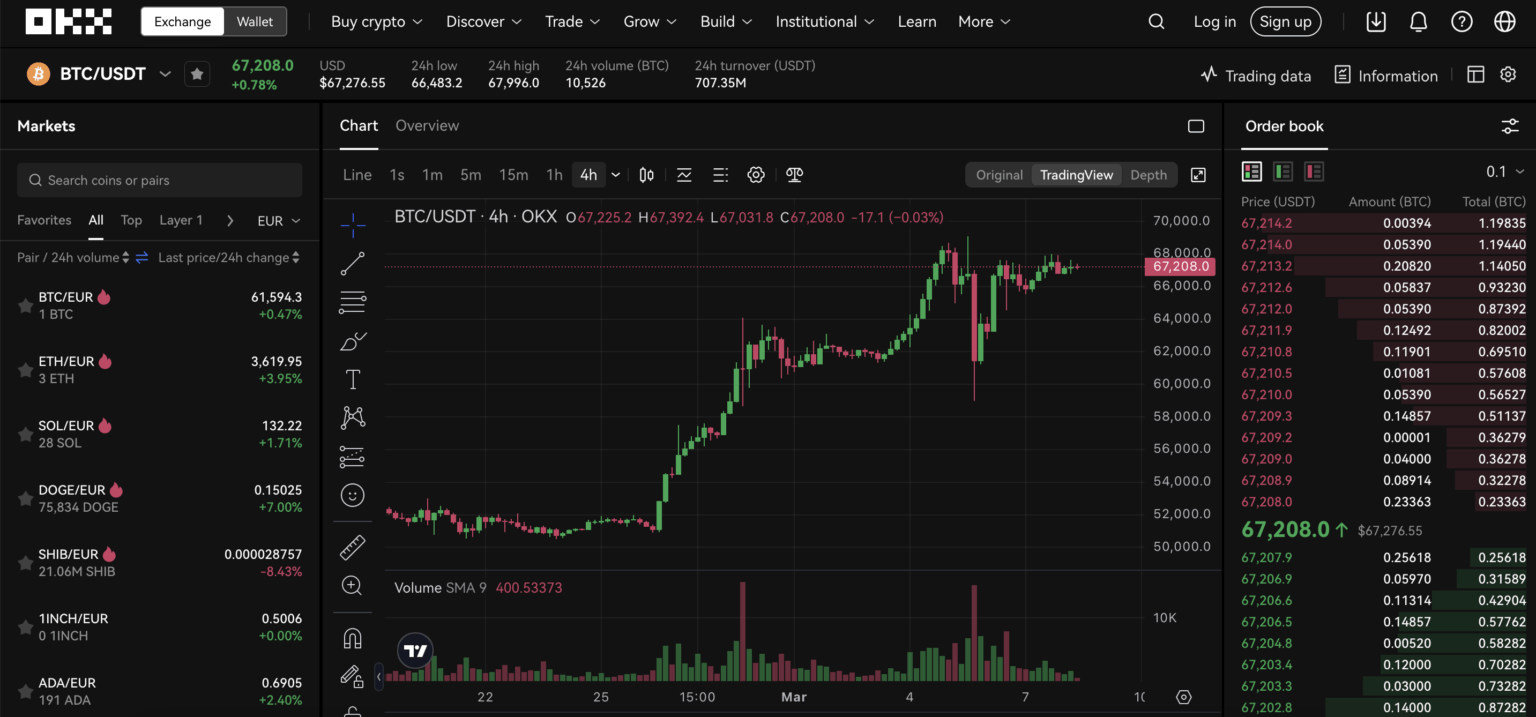
At its simplest, logging into OKX centralizes your credentials, identity, and session tokens with the exchange so you can use its CEX features: spot trading, margin (up to 10x), futures and options (up to 125x on certain contracts). There are three common login surfaces: the web platform (desktop with TradingView charts), the mobile app (with biometric login on iOS/Android), and browser extension or Web3 wallet for dApps. Identity verification (KYC) is required to open a full account — that means submitting government ID and a liveness check — which ties your on-chain and off-chain activity to a verified identity under AML rules.
Behind the scenes, OKX combines military-grade encryption, AI-driven threat detection, and mandatory two-factor authentication (2FA) options (SMS, Google Authenticator, biometrics) to protect sessions. For custodial holdings, the exchange reports storing most user funds in multi-signature, air-gapped cold wallets. Separately, OKX offers a non-custodial Web3 wallet where the user retains a seed phrase and can integrate hardware devices like Ledger or Trezor.
Side-by-side: logging in to CEX vs self-custody — trade-offs and best-fit scenarios
Comparison framework: judge on three dimensions — access to products, security model, and operational friction.
Product access: Logging into OKX’s centralized platform grants immediate access to spot markets, margin, staking, the NFT marketplace, and the DEX aggregator that sources liquidity across chains. If you want to trade newly listed spot pairs or use margin/leverage, the CEX path is the only practical route. Note: recently, OKX delisted several low-liquidity spot pairs (RSS3, MemeFi, GHST, RIO, SWEAT), a routine housekeeping step that highlights how exchanges prune markets to protect liquidity and market quality.
Security model: Centralized custody benefits from institutional controls — cold storage, multisig, insurance policies in some cases, and PoR (Proof of Reserves) transparency. But custody concentrates risk: if your account credentials are compromised through phishing, SIM-swapping, or reused passwords, attackers can move assets before any cold-storage protections engage for hot-wallet-managed balances. Self-custody (seed phrases, hardware wallets) removes counterparty risk: you control keys, and no exchange can freeze or delist your holdings. However, self-custody shifts the burden of key safety wholly to you; losing a seed phrase or falling for a malicious contract leads to permanent loss.
Operational friction: The exchange login path is faster for active trading, market access, and features like staking with auto-compound. It also supports convenience features (biometrics, browser-based TradingView). Self-custody adds friction for spot trading: you must move assets on-chain to access liquidity or use bridging tools integrated with OKX’s DEX aggregator — that incurs fees and delays, and introduces smart-contract risk.
Common myths vs reality
Myth: “If an exchange has cold storage, my account can’t be hacked.” Reality: Cold storage protects the exchange’s pooled reserves, not session-level compromise. Most retail failures involve phishing or credential theft that allows withdrawals from hot wallets or authorized transfers. The right mental model is layered defense: cold storage for systemic custody, plus strong user-side session protections.
Myth: “Using a hardware wallet is always safer.” Reality: For custody, yes — hardware wallets drastically reduce online attack surfaces. But for active US-based spot traders who need rapid execution, using only a hardware wallet creates trade-offs: slower order flow, gas or withdrawal fees, and occasional UX friction. The practical balance is hybrid: keep trading capital on-exchange with strict login hygiene while storing the bulk of long-term holdings in hardware-backed self-custody.
Login hardening checklist for US traders
Before you click to log in, apply these layered steps: enable Google Authenticator rather than SMS when possible; register a hardware security key if supported; use a password manager to generate strong, unique passwords; whitelist withdrawal addresses and enable time locks on withdrawals if available; verify the domain carefully and access OKX via a bookmarked link or this official login guidance page: okx. Treat any unexpected verification prompts with caution; contact support using verified channels, not links in emails or Telegram messages.
If you’re an active spot trader, keep a small working balance on the exchange for day trades and margin; move profit and long-term holdings to cold storage regularly. This “batched withdrawal” habit minimizes exposure from session compromise while keeping capital available for trading strategies.
Where the system breaks — limits and unresolved issues
Three boundary conditions to monitor: liquidity and delistings, identity dependencies, and external protocol risk. Exchanges routinely delist low-volume pairs to focus liquidity; if you trade niche tokens, this can strand assets or force on-chain migrations. KYC ties accounts to government ID — that provides regulatory clarity but also creates a single-point-of-failure if identity data is exposed. Finally, the DEX aggregator and bridge features reduce friction for cross-chain swaps, but they inherit smart-contract and bridge risk: faster routing is useful, yet it can route through unfamiliar contracts with differing security postures.
These are not theoretical. The delisting of several small spot pairs this month is a routine reminder that market-structure choices by an exchange can alter where and how easily you can trade an asset. Keep positions in markets with sufficient depth if execution cost matters to you.
Decision heuristics: which login model fits you?
If you are a frequent spot trader who needs fast execution, margin, and access to a wide set of coins, a properly hardened OKX custodial account is the pragmatic choice — provided you follow the login hardening checklist and maintain a regular withdrawal cadence. If your priority is holding long-term positions or interacting with DeFi dApps that require private-key control, favor the Web3 wallet or hardware custody path and accept the extra friction when moving assets to trade.
Hybrid approach: keep 5–20% of your capital in an exchange account for active trading, the rest in self-custody. That ratio depends on personal risk tolerance, tax complexity, and how comfortably you manage seed phrases or hardware devices.
FAQ
Is OKX safe to log into from the US?
OKX employs institutional controls — cold storage, PoR transparency, AI threat detection, and mandatory 2FA — which reduce systemic risk. But “safe” depends on your login practices. Phishing, SIM swaps, and reused passwords remain primary user-side risks. Use non-SMS 2FA, a password manager, and hardware security keys where possible.
Should I use the OKX Web3 wallet or stay on the exchange?
Use the Web3 wallet if you want self-custody, hardware-wallet integration, and direct DeFi/NFT interactions. Stay on the exchange if you need fast spot/margin access, staking features, or trading with leverage. Many traders split assets between both approaches to balance security and convenience.
What does delisting mean for my spot positions?
When OKX delists a spot pair, they typically warn and provide a window to trade or withdraw. Liquidity can evaporate before delisting, widening spreads; to avoid being trapped, monitor exchange announcements and move positions in assets with thin markets before delisting is announced.
How does Proof of Reserves help me?
PoR provides on-chain evidence that the exchange’s reported reserves correspond to user liabilities, improving transparency. It doesn’t eliminate user-side threats (credential theft) or guarantee against operational errors, but it reduces certain counterparty insolvency risks.
Final practical takeaway: treat login as an operational design choice, not merely a technical step. The right login posture is the intersection of product needs (spot access, margin, staking), a realistic assessment of your personal security practices, and routine behaviors (periodic withdrawals, whitelisting). If you balance those consciously, you keep most of the exchange’s convenience while avoiding the common single points of failure that cause most retail losses.